You can buy traffic. But turning that traffic into paying customers? That’s where most ecommerce brands hit a wall. Based on 10+ years of experience optimizing ecommerce funnels, we’ve found that over 70% of stores lose sales not because of poor products but because of broken conversion systems.
If you’re seeing high ad spend, steady site visits, and flat sales, the problem isn’t your product. It’s your conversion system.
This guide breaks down how to systematically improve your ecommerce conversion rate using proven CRO frameworks. By the end, you’ll know exactly where your website is losing revenue, what to fix first, and how to turn insights into profit.
What is Ecommerce CRO (and Why It Matters)
Conversion Rate Optimization (CRO) is the process of improving your website’s ability to convert visitors into customers. It’s not about redesigning your site from scratch. It’s about identifying friction points, clarifying your value, and making the path to checkout simple and effortless.
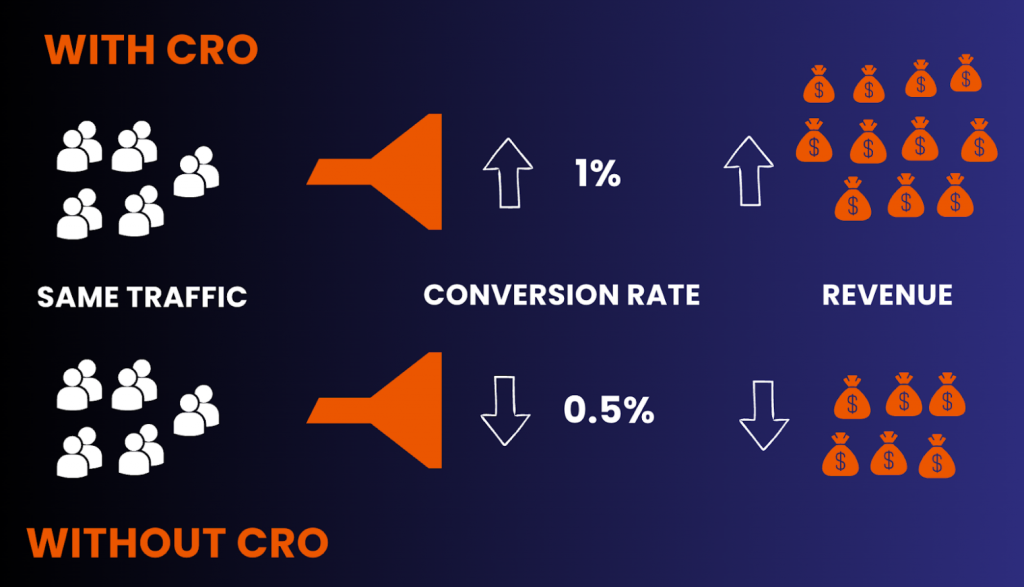
The average ecommerce conversion rate is just 2–3%, meaning 97% of your traffic leaves without buying. Even a small lift matters: a 0.5% increase in conversion rate can translate into thousands in extra monthly revenue for high-traffic stores. (source: Shopify)
Example: If your store gets 50,000 monthly visitors with a 2% conversion rate and an average order value (AOV) of $80, that’s $80,000 in revenue.
Increase conversion to 2.5%, and your revenue grows to $100,000, with no new traffic or ad spend.
Why Most Ecommerce Stores Struggle With Website Conversions
When websites underperform, founders often assume it’s the ads or audience. In reality, most issues lie inside the funnel experience:
- Slow or confusing mobile UX (about 70% of the traffic comes from mobile).
- Unclear value proposition above the fold.
- Friction at checkout: too many steps or missing payment options.
- Lack of trust signals, such as reviews, guarantees, or social proof.
- Untracked data leading to poor diagnosis and random fixes.
According to ecommerce CRO benchmarks, up to 60% of potential customers drop off before even reaching the cart page. In fashion ecommerce, average conversion rates sit around 1.7%, while DTC electronics brands often exceed 3.5%.
How to Measure Your Ecommerce Conversion Rate
The basic formula: Conversion Rate = (Number of Sales ÷ Total Visitors) × 100
For deeper insights, segment your data by:
- Device type (mobile vs. desktop)
- Traffic source (paid, organic, email, referral)
- Funnel stage (product page, cart, checkout)
Pro Tip: Track Revenue per Visitor (RPV). It combines conversion rate and AOV to give a true measure of performance.
PenPath’s 4D CRO System (Diagnose, Design, Deploy, Document)
CRO is not guesswork. It is a method. At PenPath, we use a four-part framework that simplifies optimization into a repeatable process.
In addition to this framework, PenPath’s CRO approach is guided by a proprietary CRO Playbook that uses five powerful Accelerators: Scarcity, Urgency, Guarantees, Bonuses, and Naming. These elements are built into every stage of our process to improve engagement, trust, and conversion.
Together, the 4D Framework and the 5 Accelerators form the foundation of how PenPath helps ecommerce brands turn traffic into scalable revenue.
Step 1: Audit & Diagnose
Start by identifying where your funnel is losing revenue.
Use tools such as GA4 user path reports, Microsoft Clarity, Hotjar heatmaps, Shopify Analytics, Convert.com, or Optimizely to find where users abandon sessions.
Most ecommerce stores lose up to 60% of their traffic at the product-page level before shoppers even reach the cart.
Prioritize fixes by impact and ease, then forecast potential lift to align your team.
During this Diagnose phase, PenPath applies the Scarcity and Urgency accelerators. This helps uncover customer motivation and points of hesitation, highlighting which pages need clearer offers, time-sensitive CTAs, or stronger value propositions.
Example: A client discovered that 90% of users abandoned carts on mobile because the “Add to Cart” button was hidden below the fold. Moving it up increased mobile conversions by more than double.
Step 2: Optimize the User Experience
Once you identify friction points, focus on designing a smooth, high-converting user experience, especially for mobile commerce, where most shoppers now buy.
- Keep load times under 3 seconds.
- Simplify navigation and product filters.
- Use strong CTAs like “Add to Cart” or “Checkout Securely.”
- Add trust signals, social proof, and security icons.
- Offer guest checkout and multiple payment options.
In the Design phase, PenPath incorporates the Guarantees and Bonuses accelerators. Guarantees reduce risk and build confidence, while bonuses such as “Free Shipping Today” or “Bundle and Save” increase perceived value and urgency.
Step 3: Deploy and Validate
After implementing UX and funnel improvements, validate performance with structured A/B testing for ecommerce.
Test one variable at a time, such as a headline, button color, or product layout, to isolate its impact.
Use tools like VWO, Convert.com, or Google Optimize to run statistically reliable tests.
Track both leading indicators (CTR, Add-to-Cart Rate) and lagging indicators (Sales, AOV, RPV).
Run each A/B test for at least one full purchase cycle, usually between 14 and 28 days, to reach statistical significance.
At this stage, PenPath also uses the Naming Accelerator. Strategic naming for offers and campaigns improves click intent and recognition across ads, emails, and product pages.
Step 4: Document & Scale
When your data tracking is accurate and your naming conventions are consistent, you can begin to scale CRO efforts predictably.
Create dashboards for ecommerce analytics, CRO metrics, and KPI tracking to monitor long-term performance.
Schedule regular CRO audits every quarter to maintain accuracy and momentum.
This final step combines all five Accelerators. Maintain Scarcity and Urgency campaigns, refine Guarantees, update Bonuses, and optimize Naming conventions based on performance data.
The result is a data-driven CRO framework that turns optimization into a repeatable and scalable growth system for ecommerce.
CRO vs. Website Redesign: Know the Difference
| Unit | CRO | Redesign |
| Purpose | Conversion improvement | Aesthetic overhaul |
| Timeline | Weeks (iterative) | Months |
| Focus | Data and usability | Design aesthetics |
| ROI | Measurable | Often uncertain |
| Risk | Low | High |
Key takeaway: Don’t redesign for the sake of aesthetics, optimize for outcomes. CRO delivers measurable gains faster and with less risk.
Key Metrics to Track for Ongoing Optimization
To measure the true impact of your CRO efforts, track these key metrics:
- Conversion Rate (CR): How effectively visitors buy. This is the percentage of visitors who complete a purchase.
- Average Order Value (AOV): Increases overall revenue per customer. A higher AOV means more revenue per sale.
- Cart Abandonment Rate: Indicates checkout friction. A high abandonment rate shows where customers drop off before completing their purchase.
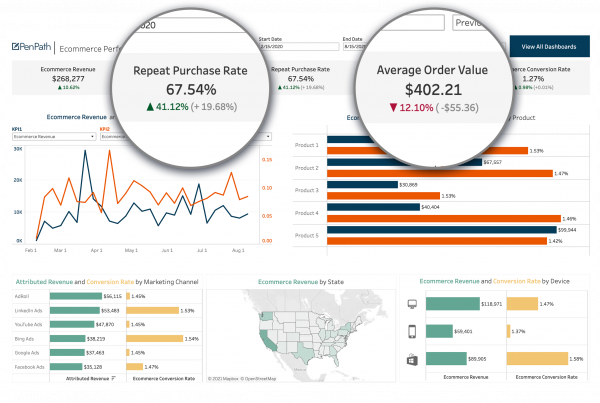
- Revenue per Visitor (RPV): Combines CR and AOV for clarity. This metric gives a clearer view of how much revenue you’re earning per visitor to your site.
- Page Speed: Every second delay can drop conversions by 4–5%. A slow site frustrates visitors, causing them to leave before purchasing.
- Customer Lifetime Value (LTV): Measures the total revenue a customer is expected to generate over their lifetime. Optimizing for LTV ensures you’re not just focusing on immediate conversions, but also long-term profitability.
Regularly tracking these KPIs ensures your CRO strategy aligns with long-term growth and profitability.
The Takeaway: Small Fixes. Big Wins.
Ecommerce CRO isn’t magic, it’s structure. When you combine data, design, and discipline, you turn the traffic you already have into predictable revenue growth.
When your data is clean, your UX is frictionless, and your testing is continuous, growth becomes repeatable and measurable.
At PenPath, we helped Trading Card Market increase their conversion rate by 79%, unlocking $80,500 in additional monthly revenue without extra ad spend. Our team identified checkout bottlenecks and improved mobile UX, transforming performance through a focused CRO audit and testing strategy.
If you’re ready to optimize your ecommerce conversions and build a scalable CRO framework, PenPath can help you identify where your website is leaking revenue and show you exactly how to fix it. Book a consultation today.